Data Policy
GAW Data Policy
"For Scientific purposes, access to these data is unlimited and provided without charge.
By their use you accept that an offer of co-authorship will be made through personal contact with the data providers
or owners whenever substantial use is made of their data.
In all cases, an acknowledgement must be made to the data providers or owners and to the data centre when these data are used within a publication."
Version
2026-06-26-1315 (Last updated: 2026-07-17)File
This data set is submitted by AEMET.
In line with the GAW Data Policy, users should contact the contributors of all data of interest and propose co-authorship or acknowledgement.
Organization
| NO | 3 |
|---|---|
| Acronym | AEMET |
| Name | State Meteorological Agency of Spain |
| Address 1 | Izana Atmospheric Research Center |
| Address 2 | C/ La Marina, 20, Planta 6, 38001 Santa Cruz de Tenerife, Spain |
| Address 3 | |
| Country/Territory | Spain |
| Website | https://izana.aemet.es/ |
Contact(s)
| Name | Pedro Rivas |
|---|---|
| Prefix | Mr. |
| privass@aemet.es | |
| Organization No | 3 |
| Organization acronym | AEMET |
| Organization name | State Meteorological Agency of Spain |
| Organization country/territory | Spain |
| Address 1 | C/ La Marina, 20, Planta 6, 38001 Santa Cruz de Tenerife, Spain |
| Address 2 | |
| Address 3 | |
| Country/territory | Spain |
| Tel | +34-922-151718 |
| Fax | +34-922-574475 |
| Last updated date | 2026-08-27 |
| Name | Carlos Torres |
|---|---|
| Prefix | Mr. |
| ctorresg@aemet.es | |
| Organization No | 3 |
| Organization acronym | AEMET |
| Organization name | State Meteorological Agency of Spain |
| Organization country/territory | Spain |
| Address 1 | C/ La Marina, 20, Planta 6, 38001 Santa Cruz de Tenerife, Spain |
| Address 2 | |
| Address 3 | |
| Country/territory | Spain |
| Tel | +34-922-151718 |
| Fax | +34-922-574475 |
| Last updated date | 2026-06-26 |
| Background observation | |
| UTC | |
| ppt | |
|
9999-12-31 00:00:00 - 9999-12-31 23:59:59: WMO SF6 X2014 |
|
|
9999-12-31 00:00:00 - 2022-12-31 23:59:59: GC-3800, Varian(Gas chromatography (ECD)) 2023-01-01 00:00:00 - 9999-12-31 23:59:59: Agilent 8890(Gas chromatography (ECD)) |
|
|
9999-12-31 00:00:00 - 9999-12-31 23:59:59: 29 (m) |
|
| 15 minutes | |
| A linear response function relative to the working standard is used. The working standard is injected every 15 minutes. The working gas tank and the instrument is calibrated every two weeks against five SF6 Izana primary standards (prepared by WMO GAW SF6 CCL). Since 2025, calibrations have been performed monthly to obtain a quadratic calibration curve. | |
|
For data prior to 2025, see References. Since 2025, a new chromatograph is used. Eight samples are automatically measured every hour, alternating between ambient air and working gas. Raw data concerning SF6 peaks are stored. Physical data for each ambient air injection are obtained using the two bracketing instrument calibrations (injections of working gas) Several procedures are used to identify, manually or automatically, periods of contamination or malfunction of the instrumental system, and the associated measurements are discarded. |
|
|
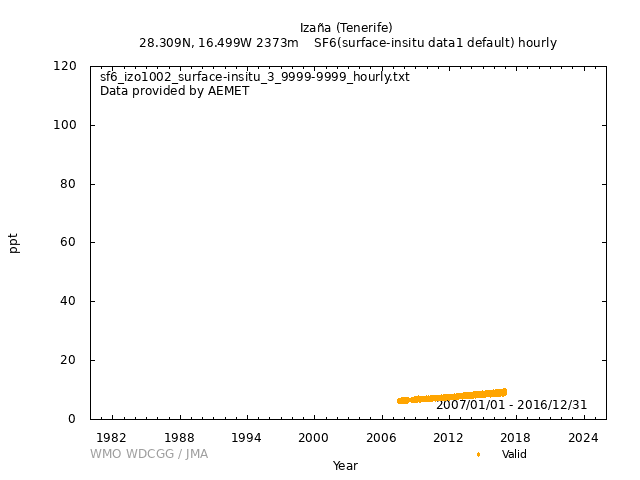
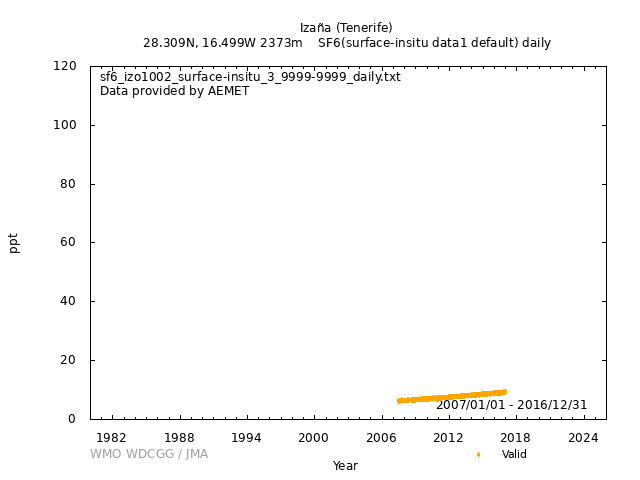
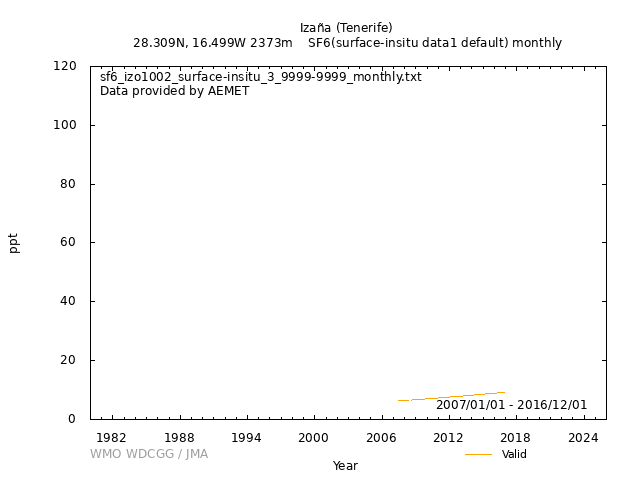
[Hourly] Hourly data are computed averaging the corresponding physical data for valid ambient injections. SD -> standard deviation of the sample. [Daily] The daily mean for the day "n" is computed averaging the corresponding available hourly means between 20:00 UTC of day "n-1" and 08:00 UTC of day "n" (so, they could be called "daily night means"). The atmospheric conditions at the station during the night correspond to background pure free troposphere. SD: standard deviation of the sample of hourly means. ND: number of hourly means available for computing the daily night mean (max=12). [Monthly] Monthly data are computed averaging the corresponding daily night means. SD: standard deviation of the sample of daily night means. ND: number of valid daily night means used. |
|
| Operational/Reporting | |
|
Scientific Aim : To determine temporal variability of atmospheric SF6 at Izaña (North Atlantic free troposphere background conditions): short-term variability, seasonal variability and long-term trend. To provide data to WDCGG as a Global GAW station. The Izaña station is located at 2372.90 m above see level, on the Island of Tenerife, Spain. The ground in the vicinity around Izaña is loosely covered with light volcanic soil. The vegetation in the surrounding area is sparse, consisting mainly of broom. A belt of pine forest grows between 1000 and 2000 meters a.s.l. During nighttime (20UTC-08UTC), in situ measurements are representative of free troposphere background conditions. This is due to the following facts: a) usually a strong subtropical temperature inversion layer is located at a lower altitude than Izana station; b) Izana station is located on the top of a crest, so during the night period downslope wind produces (by mass conservation) the arrival of free troposphere air to Izana. During daytime, small amounts of air coming from the forest can arrive to the station due to surface upslope wind produced by ground diurnal heating. Apart from this effect, there is no arrival of polluted air from the rest of the island, due to the presence of the strong subtropical temperature inversion layer. The general ambient air inlet, which provides ambient air for all instruments that analyze it, is an 8cm inner diameter (ID) stainless steel pipe and has a high flow rate. This inlet is situated on top of the building tower, 29 m above the ground. Upstream of the instrument, a cryocool trap is used to reduce the dew point of ambient air to -70 ºC. |
|
|
Wind direction: 1 Wind speed: 1 Relative humidity: 1 Precipitation amount: 0 Air pressure: 0 Air temperature: 1 Dew point temperature: 0 Sea water temperature: 0 Sea surface water temperature: 0 Sea water salinity: 0 Sea surface water salinity: 0 |
|
|
Meteorological data may remain as first provided, even when greenhouse gas data are updated. |
No DOI available
Related information
GAW Data Policy
"For Scientific purposes, access to these data is unlimited and provided without charge.
By their use you accept that an offer of co-authorship will be made through personal contact with the data providers
or owners whenever substantial use is made of their data.
In all cases, an acknowledgement must be made to the data providers or owners and to the data centre when these data are used within a publication."
Citation format
This format is an example of the WDCGG standard citation.
Please follow the citation format which the data providers or owners indicate.
Please follow the citation format which the data providers or owners indicate.
Pedro Rivas (AEMET),
Carlos Torres (AEMET),
Atmospheric SF6
at Izaña (Tenerife) by State Meteorological Agency of Spain,
dataset published as SF6_IZO1002_surface-insitu_AEMET_data1 at WDCGG,
ver. 2026-06-26-1315 (Reference date*: YYYY/MM/DD)
* As the reference date, please indicate the date you downloaded the files.
* As the reference date, please indicate the date you downloaded the files.
Reference(s)
| 1 | Gomez-Pelaez, A.J., Ramos, R., "Installation of a new gas chromatograph at Izaña GAW station (Spain) to measure CH4, N2O, and SF6" in GAW Report (No. 186) of the "14th WMO/IAEA meeting of experts on Carbon dioxide, other greenhouse gases, and related tracers measurement techniques (Helsinki, Finland, 10-13 September 2007)", edited by Tuomas Laurila, World Meteorological Organization (TD No. 1487), 55-59, 2009 |
|---|---|
| 2 | Gomez-Pelaez, A.J., R. Ramos, V. Gomez-Trueba, R. Campo-Hernandez, E. Reyes-Sanchez: "GGMT-2015 Izaña station update: instrumental and processing software developments, scale updates, aircraft campaign, and plumbing design for CRDS" in GAW report (No. 229) of the "18th WMO/IAEA Meeting on Carbon Dioxide, Other Greenhouse Gases, and Related Measurement Techniques (GGMT) (La Jolla, CA, USA, 13-17 September, 2015)", edited by P. Tans and C. Zellweger, World Meteorological Organization, 125-131, 2016 |